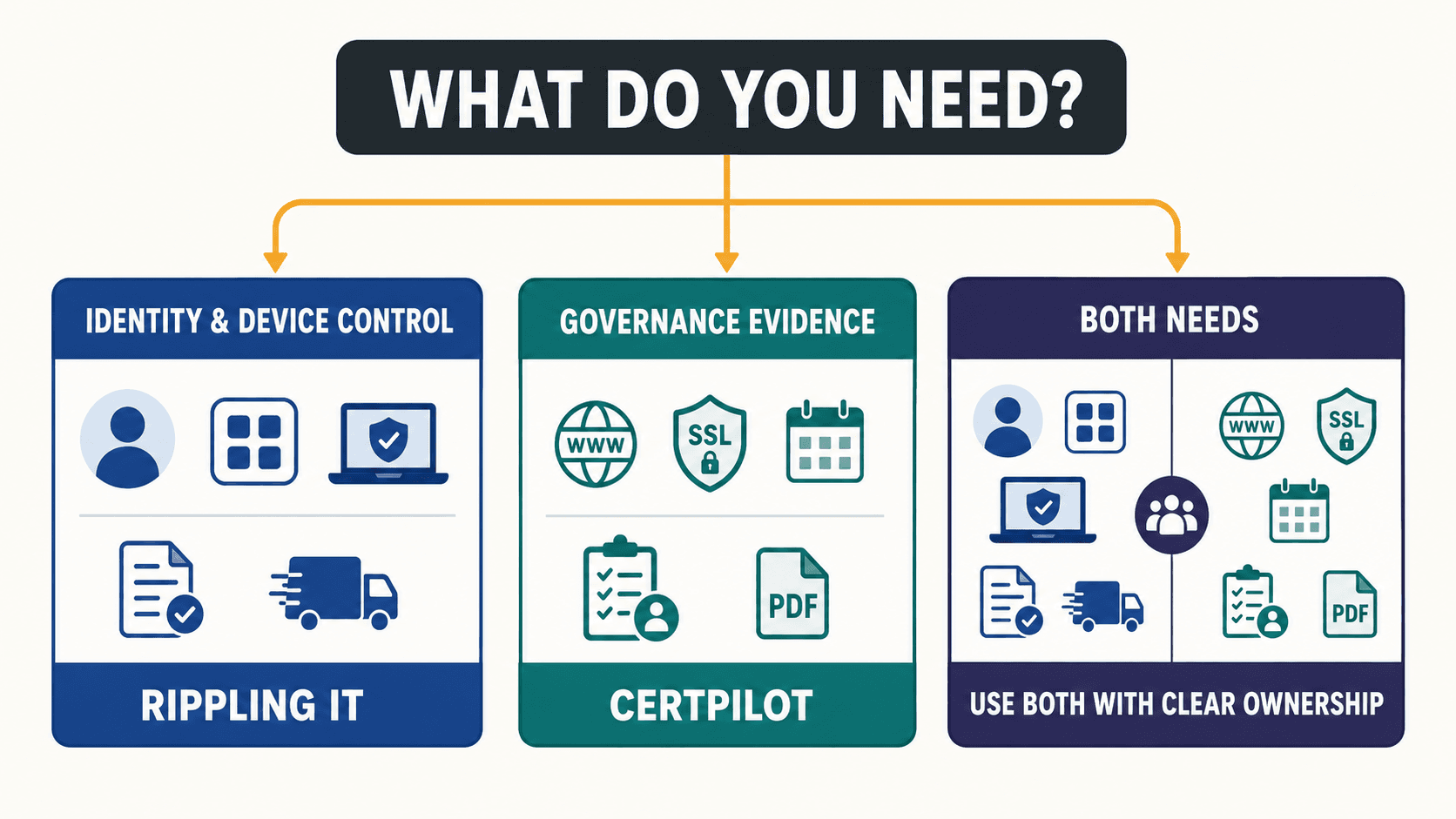
Rippling and CertPilot solve different IT management problems.
Choose Rippling IT when you need to provision and revoke application access, enforce SSO or MFA, enrol and control devices, deploy software, patch or wipe endpoints, and manage device shipping and retrieval.
Choose CertPilot when you already have—or do not need—those control systems, but need a lighter way to run public domain checks, maintain IT registers, complete access reviews, track renewals, and generate dated governance evidence for management, clients, or audit conversations.
This is not a feature-for-feature replacement comparison. Rippling is primarily a system of control and automation. CertPilot is an IT governance evidence platform. A team may choose one, neither, or both depending on whether the missing capability is enforcement, evidence, or both.
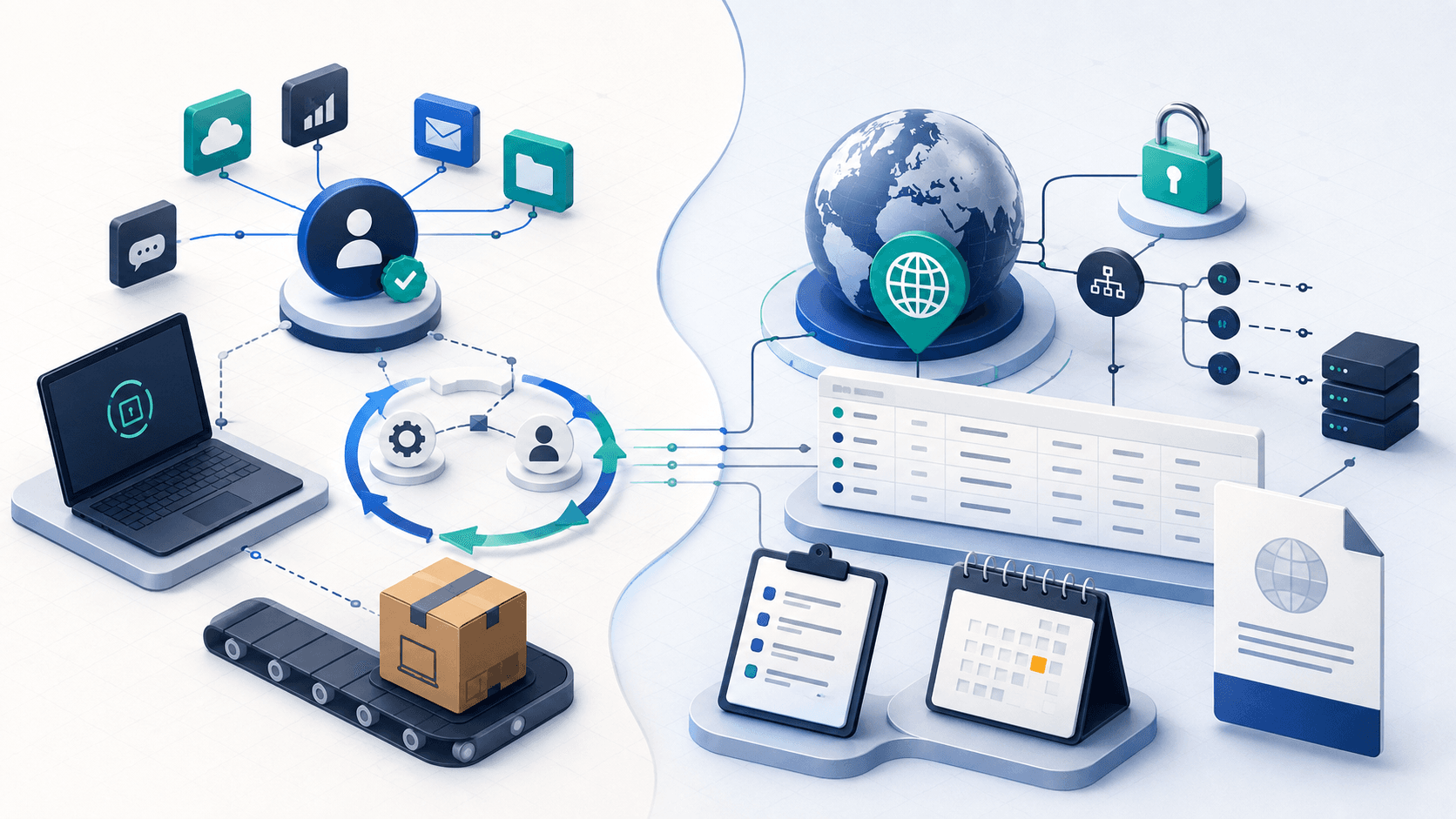
In short
-
Rippling is the stronger fit for active identity and endpoint control tied to the employee lifecycle.
-
CertPilot is the stronger fit for lightweight, manual-first registers, credential-free public checks, and management-ready evidence reports.
-
CertPilot cannot replace Rippling IAM or MDM. It has no SSO, provisioning, directory sync, device agent, policy enforcement, patching, remote lock, or remote wipe.
-
Rippling's inventory product manages physical device logistics. CertPilot's Assets Register records ownership, location, status, and software-license context; it does not procure, ship, retrieve, warehouse, scan, or dispose of equipment.
-
Rippling Automated Compliance is designed around SOC 2 readiness, controls, evidence collection, remediation, and audit workflows. CertPilot produces operational evidence only and does not certify compliance or run an audit.
-
Rippling publishes custom-quote pricing. CertPilot currently publishes flat per-workspace pricing starting at €99 per month,.
-
If Rippling already supplies every report and public-signal check your team needs, adding CertPilot may create duplicate records. If your IdP or MDM handles control but leaves renewals, public domains, access-review sign-off, and management evidence scattered, CertPilot can sit beside it.
Is CertPilot really a Rippling IT alternative?
Only for a specific buying question: Do you need an active IT control platform, or a lighter governance evidence layer?
Rippling IT combines identity and access management, device management, inventory management, and automated compliance. It connects those capabilities to workforce data so a hire, role change, or departure can trigger access and device actions.
CertPilot combines automated checks of public technical signals with customer-maintained registers and on-demand PDF reports. Its People & Accounts, Assets, Renewals, and Access Reviews modules organize records that a small team might otherwise keep in spreadsheets. It does not use those records to control applications or endpoints.
That creates three valid answers:
-
Rippling instead of CertPilot: you need one platform to act on identities, devices, and workforce events, and Rippling's reports cover your evidence requirements.
-
CertPilot instead of Rippling: you already use other tools for identity and devices—or do not need active management—and your real problem is maintaining records and producing recurring evidence.
-
Rippling with CertPilot: Rippling controls identities and endpoints; CertPilot covers public domains, renewal ownership, manual governance registers, and a separate management evidence workflow.
The third option is not an integration claim. CertPilot has no live Rippling connector. Records would be maintained or transferred manually, usually by CSV, and each system would remain responsible for its own job.
Rippling vs CertPilot: side-by-side comparison
Capability comparison at a glance
- Primary job: Rippling IT is a workforce-linked IT control and automation platform. CertPilot is for IT governance checks, registers, and evidence reports. Conclusion: different operating models.
- Identity directory: Rippling is built around live employee and agent identity data. CertPilot stores customer-maintained people and account records. Use Rippling for a live identity source; use CertPilot for a manual evidence register.
- SSO and MFA: Rippling supports SSO, MFA, conditional access, password management, and related identity controls. CertPilot does not. Use Rippling.
- Provisioning and deprovisioning: Rippling automates app access based on roles, policies, risks, and lifecycle events. CertPilot does not provision, deprovision, or remove accounts. Use Rippling.
- Access reviews: Rippling can use live access data inside its identity and compliance platform. CertPilot provides a manual access register, Systems Catalog, matrix, reminders, completion log, CSV, and Access Review Register PDF. Choose based on whether live enforcement or manual evidence is the priority.
- MDM: Rippling manages Apple and Windows device surfaces. CertPilot has no MDM. Use Rippling.
- Endpoint actions: Rippling covers configuration, encryption enforcement, software deployment, OS updates, scripts, lock, wipe, and endpoint-security workflows. CertPilot has no device agent or endpoint action. Use Rippling.
- Device inventory: Rippling is stronger for live fleet data connected to users and managed devices. CertPilot is a manual-first hardware register. Use Rippling for live fleet data; use CertPilot for a maintained ownership record.
- Device logistics: Rippling covers ordering, shipping, retrieval, warehousing, reassignment, and buyback. CertPilot does not. Use Rippling.
- Software register: Rippling has app, access, licence, and workforce context across its suite. CertPilot stores customer-entered software name, vendor, version, licence status, assignee, renewal date, and masked key hint. Different depth and source of truth.
- SaaS discovery and usage: Rippling describes app and OAuth visibility, shadow-tool detection, and licence reclamation. CertPilot has no automatic SaaS discovery or usage analysis. Use Rippling.
- Public domain checks: Rippling IT does not present this as its core job. CertPilot runs daily SSL/TLS, DNS, RDAP/domain-expiry, and email-authentication checks. Use CertPilot.
- Vendor renewals: CertPilot has a defined manual-first renewal evidence workflow for subscriptions, contracts, licences, owners, notice dates, decisions, and renewal risk. Use CertPilot for that workflow.
- Vendor status signals: CertPilot provides a workspace watchlist using official public vendor status feeds. Use CertPilot when this evidence matters.
- Compliance automation: Rippling is stronger for SOC 2-oriented controls, continuous evidence collection, monitoring, remediation, risk, policy, vendor, and audit workflows. CertPilot does not run a control framework or remediation workflow. Use Rippling for compliance automation.
- Governance evidence PDFs: CertPilot has six on-demand report types with public samples. Evaluate the exact artifact each stakeholder needs.
- Google Workspace or Microsoft 365 connector: Rippling supports integrations and offboarding actions across connected apps. CertPilot has no connector or directory sync today. Use Rippling.
- Private system access: Rippling uses connected workforce, identity, app, and device data. CertPilot public checks need no credentials; registers are entered or imported by the customer. Choose based on required automation and acceptable access.
- Compliance certification: Neither product certifies your organization. An independent auditor still issues an audit report. Neither.
- Published pricing model: Rippling is custom quote. CertPilot is flat per workspace with published plans starting at €99/month. Compare a real quote against the workflow you will actually use.
This table compares documented product capabilities as of 21 August 2026. It does not assume that every Rippling module is included in every quote or that buying one module unlocks the entire suite.
The core difference: control plane vs evidence layer
The fastest way to choose between the two products is to separate four verbs: discover, enforce, record, and prove.
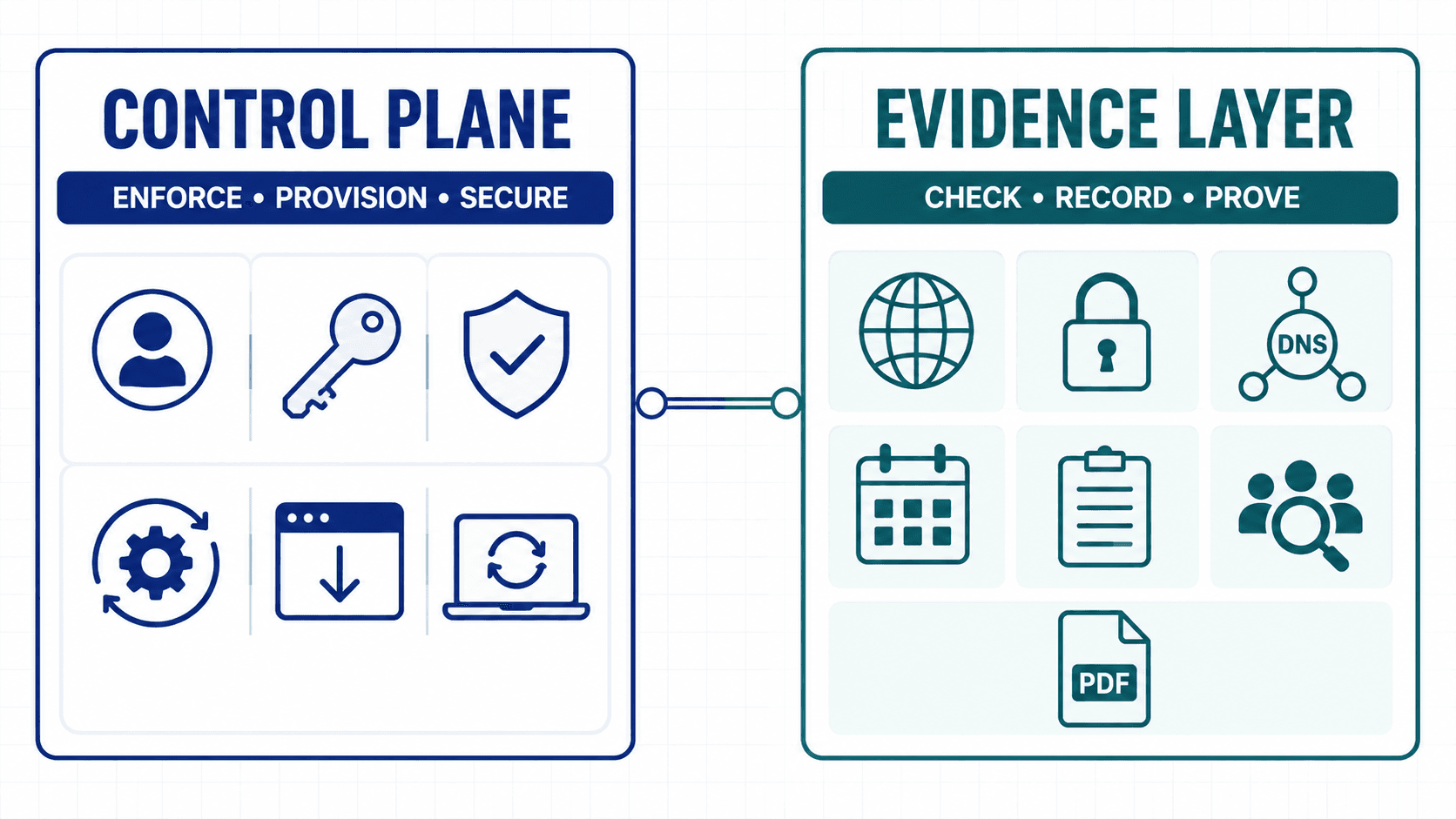
Rippling discovers or receives live workforce, app, and device context, then uses policies and workflows to enforce changes. When a person joins, changes role, or leaves, that event can affect application access, device configuration, security controls, and device logistics.
CertPilot records customer-authorized governance context and proves that defined checks and reviews happened. It automates checks only where data is public: SSL/TLS, DNS, RDAP/domain registration, email-authentication records, and supported official vendor-status feeds. Internal people, accounts, assets, renewals, systems, and access decisions remain customer-maintained.
Neither model is inherently better. The right model depends on the failure you are trying to prevent:
-
If the risk is a former employee keeping application access, you need an IdP, IAM, or lifecycle automation system that can revoke access.
-
If the risk is nobody being able to show that the quarterly review happened, you need a review record and evidence artifact.
-
If the risk is an unencrypted laptop, you need MDM or endpoint controls that can detect and remediate the device.
-
If the risk is an asset register with no owner or location, you need a maintained ownership record.
-
If the risk is an expired domain, broken email-authentication record, or missed SaaS renewal, you need public checks and renewal ownership beyond endpoint management.
Many lean teams need more than one of these jobs covered. A comparison should identify the system accountable for each job rather than forcing one product to pretend it does everything.
Rippling IAM vs CertPilot People & Accounts and Access Reviews
What Rippling IAM does
Rippling Identity and Access Management is an active identity product. Rippling says it can provision or revoke access based on role changes, risk signals, and company policy. Its published capabilities include SSO, MFA, role-based access, group management, password management, user provisioning, conditional access, and support for protocols and integrations such as SAML, SCIM, OIDC, LDAP, and RADIUS.
That matters during the full user lifecycle:
-
a new employee can receive application and group access;
-
a role change can update permissions;
-
an offboarding event can suspend or revoke access;
-
identity and device attributes can feed conditional rules;
-
the current state can be reported from live connected data.
If the requirement says grant, deny, authenticate, provision, suspend, or revoke, CertPilot is not the alternative. Use Rippling or another IAM/IdP product.
What CertPilot does instead
CertPilot People & Accounts is a manual-first register. It records people, roles or titles, departments, person status, system accounts, account identifiers, account status, relevant dates, and notes. Teams can import and export CSV data and use an accounts matrix. There is no Google Workspace, Microsoft 365, HRIS, or identity-provider sync, and CertPilot does not remove accounts.
CertPilot Access Reviews provides a separate evidence workflow: a Systems Catalog, access matrix, entries view, review states, due dates, action-required follow-up, reminder emails, an immutable Completion Log, and an Access Review Register PDF. A completed review event records the reviewer, review period, cadence, next due date, notes, and snapshot counts.
The distinction is operationally important:
-
Rippling can change access in connected systems.
-
CertPilot can record the team's access decision and the fact that a review was completed.
-
In CertPilot, any removal or permission change still happens in the underlying application.
Where Rippling enforces conditional access, CertPilot only helps you review and document which users, groups, roles, and guests are excluded from an existing Conditional Access policy — it does not create, change, or enforce any policy.
Choose CertPilot's approach when the organization intentionally wants a lightweight, human-authorized review register and does not want to connect a directory. Choose Rippling when current access must be pulled from live systems and policies must act on it.
Rippling MDM vs CertPilot Assets Register
What Rippling Device Management does
Rippling Device Management is built to enrol, configure, secure, monitor, and take action on endpoints. Rippling documents support for Apple and Windows device lifecycles, including configuration profiles, software installation, encryption enforcement, OS updates, scripts, endpoint protection, zero-touch deployment, and remote lock or wipe.
This is what MDM is for: converting a device policy into a technical state on the device. An inventory row saying “encrypted” is not equivalent to enforcing FileVault or BitLocker and checking the current result.
What CertPilot Assets Register does
CertPilot Assets Register is a customer-maintained hardware and software register. Hardware records can include the assigned person, department, location, serial or service tag, brand, model, specifications, purchase context, status, maintenance notes, and evidence gaps. Software records can include vendor, version, licence type and status, assignee, renewal date, purchase date, licence reference, and a key-present flag with a short masked hint. Full product keys are not stored.
CertPilot does not:
-
enrol devices;
-
detect devices on a network;
-
collect device telemetry;
-
discover installed software;
-
enforce encryption or password policy;
-
patch operating systems;
-
install or remove applications;
-
lock or wipe endpoints;
-
replace Intune, Jamf, Kandji, Rippling MDM, or another endpoint-management tool.
Assets appear in CertPilot's cross-module Governance Evidence Pack as summary counts only. There is no dedicated Assets PDF today, and owner-level details, serial numbers, licence references, and key hints are not printed in that pack.
Choose Rippling when the device must be controlled. Choose CertPilot when the organization needs a lightweight ownership and lifecycle register without installing software on endpoints. Use both only if the separate governance register and report are valuable enough to justify maintaining them.
Rippling Inventory Management vs CertPilot's asset and renewal records
The word “inventory” hides two different jobs.
Rippling Inventory Management handles the physical device lifecycle: ordering, routing, retrieval, warehousing, reassignment, condition and location reporting, buyback, and secure disposal. Rippling says offboarding can trigger a return flow with a shipping box, label, and tracking. Its UK page also notes that the Rippling Store is currently available only in the US and Canada, so buyers elsewhere should confirm which procurement and logistics services are available in each country.
CertPilot tracks the record, not the logistics. Its Assets Register can answer questions such as:
-
Which laptop is assigned to this person?
-
Which monitor or shared device is in this room?
-
Which assets are active, spare, under repair, lost, or retired?
-
Which records have no owner, location, serial, or purchase reference?
-
Which software licence has a renewal date or incomplete licence context?
The Renewals & Vendor Register adds subscriptions, contracts, licence renewals, owners, billing contacts, notice deadlines, auto-renew state, decisions, last-reviewed dates, and renewal-risk reporting.
It does not generate barcodes, run check-in/check-out, calculate depreciation, place purchase orders, ship boxes, retrieve equipment, warehouse stock, or issue destruction certificates.
For a distributed workforce with frequent onboarding and offboarding, physical logistics may be the decisive requirement; Rippling is the relevant product. For a small organization that already buys and handles its own equipment but needs an accountable register and renewal evidence, CertPilot may be sufficient.
Rippling Automated Compliance vs CertPilot governance evidence
This is the area where wording matters most because compliance automation and operational evidence are not synonyms.
Rippling's compliance model
Rippling Automated Compliance is positioned around SOC 2 readiness. Rippling describes control and policy recommendations, continuous monitoring, evidence collection from people, device, access, training, and vendor data, remediation in the same platform, risk and vendor management, audit planning, and auditor collaboration.
Rippling also states that an independent auditor determines the scope, performs the audit, and issues the report. Buying the software is not the same as receiving a SOC 2 report.
This model is compelling when Rippling is already the system of record and action for the evidence in scope. First-party operational data can reduce the number of integrations and manual screenshots needed for audit preparation.
CertPilot's evidence model
CertPilot Evidence Reports turn public checks and customer-maintained registers into six on-demand PDF formats:
-
Domain Health;
-
Renewal Risk;
-
Monthly Proof;
-
Weekly Governance, generated on demand rather than automatically delivered each week;
-
Access Review Register; and
-
Governance Evidence Pack.
The reports can support management reviews, client conversations, security questionnaires, insurer requests, and audit preparation. They do not implement a control framework, collect continuous evidence from private systems, manage policies, remediate a failed control, run an audit, certify SOC 2, ISO 27001, NIS2, GDPR, or any other regime, or guarantee that an auditor will accept a specific artifact.
CertPilot's methodology documents the public sources and interpretation boundaries behind its automated checks. The sample reports gallery uses fictional data so a buyer can inspect the artifact before signing up.
Choose Rippling Automated Compliance when the objective is a SOC 2-oriented control, collection, remediation, and audit workflow tied to live operations. Choose CertPilot when the objective is narrower: produce a dated, understandable record of public checks, maintained registers, renewal state, and access-review activity without deploying enterprise GRC.
Where CertPilot adds coverage outside Rippling's four IT categories
Rippling's four categories are identity and access, device management, inventory, and automated compliance. CertPilot has several narrower surfaces that are not substitutes for those categories but may close gaps around them.
Public external-footprint checks
CertPilot runs daily checks on public SSL/TLS certificate state and expiry, DNS records and changes, RDAP/domain-registration status and expiry where available, and domain-level email authentication such as MX, SPF, DMARC, MTA-STS, TLS-RPT, and BIMI.
These checks do not require registrar, DNS-provider, mailbox, IdP, or device credentials. They do not scan for vulnerabilities or monitor uptime.
Renewal ownership and decisions
CertPilot keeps SaaS tools, hosting, domains, licences, certificates, and contracts in one Renewals & Vendor Register. The value is not automatic discovery; there is none. The value is a consistent record of owner, renewal and notice dates, billing context, auto-renew state, decision, review date, and incomplete or overdue records.
Official vendor-status context
Vendor Status Watch tracks supported official public status signals for SaaS, cloud, productivity, and developer vendors on a workspace watchlist. It shows vendor-reported incidents and maintenance context. It does not test the customer's tenant, replace incident monitoring, or prove that a public incident caused a specific internal problem.
These surfaces are useful when the IT control platform stops at the employee, application, and device boundary, while the operational evidence request includes public domains, renewals, and vendor context.
Pricing and implementation model
Pricing should be compared only after the required modules and workflows are clear.
Rippling's UK pricing page asks buyers to request a custom quote. It says individual HR, Finance, and IT products can be purchased separately alongside the required core Rippling Platform; most products use per-employee, per-month billing, while some may include a monthly base fee. A useful quote should therefore list the core platform, IAM, MDM, inventory/logistics, automated compliance, implementation, and any region-specific services separately.
CertPilot publishes flat monthly prices by workspace and evidence volume. As of the verification date, the standard plans shown on CertPilot's pricing section are:
- Starter — €99/month: one lean team; all live registers and reports; up to 100 monitored domains.
- Professional — €199/month: multi-team or multi-client grouping, branded reports; up to 250 monitored domains.
- Portfolio — €299/month: larger registers and client rosters; up to 500 monitored domains.
The implementation burden is also different. Rippling's value increases when it receives accurate employee data, connects applications, enrols devices, and becomes part of onboarding and offboarding. CertPilot can start with domains and CSV imports without agents or private connectors, but its internal registers remain accurate only when humans maintain them.
Do not compare €99 with a Rippling quote as if the products deliver the same controls. Compare the total cost of the system that meets the requirements—including the administrative work left outside it.
Which should you choose? A requirement-by-requirement decision guide
- Automatically provision and revoke SaaS access: choose Rippling.
- Provide SSO, MFA, conditional access, or password management: choose Rippling.
- Apply security settings, install software, patch, lock, or wipe endpoints: choose Rippling.
- Automate device purchase, shipping, return, warehousing, or buyback: choose Rippling.
- Run a SOC 2 readiness workflow with continuous operational evidence and remediation: choose Rippling Automated Compliance.
- Keep a manual people-and-accounts register without connecting a directory: choose CertPilot.
- Run a structured manual access review with completion evidence and a dedicated PDF: choose CertPilot, or compare its artifact with Rippling's live access-review workflow.
- Keep a lightweight hardware and software ownership register without an endpoint agent: choose CertPilot.
- Check public SSL, DNS, domain expiry, and email-authentication records daily: choose CertPilot.
- Track vendor and subscription renewals with owners, notice dates, and decisions: choose CertPilot.
- Generate a plain-English cross-module governance evidence pack: choose CertPilot.
- Control endpoints and also document public-domain and renewal governance: use Rippling plus CertPilot only if maintaining two systems is justified.
- Certify compliance or guarantee an audit outcome: neither; use a qualified independent auditor and appropriate advisers.
Choose Rippling when
-
Workforce events should drive IT changes automatically.
-
The organization wants identity, device, logistics, and compliance workflows on one employee data model.
-
Live system state is more important than a customer-maintained register.
-
The team needs technical enforcement, not just reminders and records.
-
The organization is prepared to connect applications, enrol devices, define policies, and implement lifecycle workflows.
Choose CertPilot when
-
The team already has an IdP, MDM, RMM, or other control system and does not want to replace it.
-
The missing layer is structured evidence across domains, renewals, people, assets, and access reviews.
-
Public checks should run without credentials or agents.
-
Manual-first records are acceptable and preferable to broad private-system access.
-
A dated PDF for a manager, client, or review conversation matters more than live endpoint enforcement.
-
A per-workspace product is a better fit than a broad workforce platform.
Choose both when
-
Rippling is the action layer for identity and devices.
-
CertPilot's external checks, renewal register, vendor-status context, or evidence-report format solve a separate documented need.
-
The team assigns an owner for any manual data transfer and accepts that no live connector exists.
-
The same record is not maintained twice without a defined reason.
Choose neither when
-
Your current IdP, MDM, asset platform, and reporting process already meet the requirement.
-
You need a full GRC suite, policy library, multi-framework control mapping, audit-management platform, SIEM, RMM, CMDB, ITSM, vulnerability scanner, or infrastructure monitor.
-
Nobody will own implementation in Rippling or register maintenance in CertPilot.
A practical 30-day evaluation plan
Do not choose from a generic feature list. Test the events that create real IT risk.
Week 1: define the jobs and owners
Write down the systems that are authoritative today:
-
HR or workforce source;
-
identity provider and application directory;
-
MDM or endpoint tool;
-
physical device inventory;
-
SaaS and vendor renewal record;
-
domain and certificate monitoring;
-
access-review record;
-
management and audit evidence output.
For each system, name the owner and the failure you are trying to prevent. “Improve compliance” is too vague. “Revoke access within four hours of an approved offboarding” or “produce a dated quarterly access-review artifact in under 15 minutes” can be tested.
Week 2: run six lifecycle scenarios
Test these with representative—not production-sensitive—data:
-
onboard a new employee with a defined role;
-
move that employee to another role;
-
offboard the employee;
-
mark a laptop lost and define the required response;
-
identify a subscription inside its notice window with no decision;
-
complete an access review and generate the artifact a stakeholder receives.
For each scenario, separate the action from the evidence. Record which product detects the event, which product changes the underlying system, which human approves the change, and where the final record lives.
Week 3: inspect the evidence, not just the dashboard
Ask a manager, auditor, client lead, or security reviewer to inspect exported results without a product tour. Can they answer:
-
What was in scope?
-
When was the information checked or reviewed?
-
What is healthy, incomplete, overdue, or action required?
-
Who owns the follow-up?
-
Which facts came from live systems, public checks, or customer-entered records?
-
What does the artifact explicitly not prove?
This is where CertPilot's public sample reports are useful: the team can judge the deliverable before importing real records. For Rippling, ask sales to demonstrate the exact reports and audit exports included in the proposed modules.
Week 4: calculate operating cost and make the boundary explicit
Include more than subscription price:
-
implementation and connector setup;
-
device enrolment and application integration;
-
policy design and testing;
-
user or workspace charges;
-
device shipping and regional service costs;
-
register maintenance and CSV work;
-
monthly evidence preparation;
-
duplicate record reconciliation;
-
offboarding and exception handling;
-
training and ownership when the administrator is absent.
Finish with a one-page responsibility map. Every critical job should have one accountable system and one human owner. If both platforms hold the same field, state which is authoritative and why.
Ten questions to ask before buying either product
-
Which exact event triggers onboarding, role-change, and offboarding workflows?
-
Which applications and device operating systems are supported in our required configuration?
-
Does the system only report a problem, or can it enforce and remediate the state?
-
Which data is live, which is imported, and which is maintained manually?
-
What happens when a connector, device agent, public source, or human-maintained register is stale?
-
Can we export the underlying records and the final evidence artifact?
-
Which modules, base fees, implementation services, and regional logistics are included in the quote?
-
Can a non-technical stakeholder understand the exported report without dashboard access?
-
What does the product explicitly not certify, monitor, discover, or control?
-
Who on our team will own the system after the initial implementation?
The best answer is not the platform with the longest feature list. It is the operating model the team can maintain—and the one that closes the specific failure mode without creating a second source of truth by accident.
The bottom line
Rippling is the better choice for identity enforcement, device control, lifecycle automation, physical device logistics, and SOC 2-oriented compliance automation. Those capabilities depend on workforce, application, and endpoint data, and they can take action when state changes.
CertPilot is the better choice for credential-free public checks, manual-first IT registers, renewal and access-review evidence, and dated management PDFs. It is intentionally narrower and does not claim to replace IAM, MDM, ITAM, GRC, or an auditor.
If your question is “How do we automatically control access and devices when an employee joins or leaves?”, evaluate Rippling.
If your question is “How do we keep domains, renewals, people, assets, and access reviews organized—and prove the work without deploying a large platform?”, evaluate CertPilot.
If you have both questions, define which product controls the live system and which product produces the additional evidence before buying both.
Explore the CertPilot platform, inspect the sample evidence reports, or start the published 14-day trial if the evidence-layer model matches your requirement.
Sources and verification notes
This comparison was last checked on 21 August 2026 against official product pages:
-
Rippling: IT overview, Identity and Access Management, Device Management, Inventory Management, Automated Compliance, and UK pricing.
-
CertPilot: Platform, People & Accounts, Access Reviews, Assets Register, Evidence Reports, methodology, sample reports, and product boundaries.
Product packaging, pricing, regional logistics, integrations, and supported operating systems can change. Recheck the official pages and the final vendor quote before publishing a purchasing decision. “Rippling” and related product names are trademarks of their respective owner; this is an independent comparison based on publicly documented capabilities.
Frequently Asked Questions
Is CertPilot a Rippling alternative?
CertPilot is a Rippling IT alternative only when the required outcome is lightweight governance evidence rather than active identity and device control. Rippling can provision and revoke application access, enforce identity policies, enrol and manage endpoints, automate device logistics, and support a SOC 2 readiness workflow. CertPilot does none of those control-plane jobs. It runs public domain checks, provides customer-maintained registers for renewals, people, accounts, assets, and access reviews, and generates on-demand evidence PDFs. Choose Rippling when systems must change automatically as employees join, move, or leave. Choose CertPilot when existing tools already handle control—or no control platform is needed—and the missing problem is organized records and management-ready evidence.
Can CertPilot replace Rippling IAM?
No. CertPilot cannot replace Rippling IAM, an identity provider, or an access-provisioning system. It has no SSO, MFA, conditional access, password manager, directory sync, SCIM provisioning, or automatic account suspension and removal. CertPilot's People & Accounts module is a customer-maintained register, while Access Reviews records access levels, review status, follow-up, completion events, and due dates. A reviewer can decide that access should be removed and record that decision in CertPilot, but an administrator must make the change in the underlying application. If your requirement uses verbs such as authenticate, grant, enforce, provision, suspend, or revoke, use Rippling or another IAM product.
Can CertPilot replace Rippling MDM?
No. CertPilot is not MDM and cannot configure, monitor, patch, lock, or wipe a device. Its Assets Register records customer-entered hardware and software context such as assignee, location, status, serial or service tag, purchase details, licence status, and renewal date. It does not install an agent, enrol endpoints, discover devices, read installed software, enforce encryption, deploy applications, or take remote action. Rippling Device Management is the relevant product when technical policy must be applied to Apple or Windows devices. CertPilot may sit beside an MDM when a separate ownership register or governance evidence summary is useful, but the team should avoid duplicating fields without naming an authoritative source.
Which product is better for IT inventory management?
Rippling is better for active, distributed device inventory and logistics; CertPilot is better for a lightweight, manually maintained ownership register. Rippling can connect devices to employees, report condition and location, and support ordering, shipping, retrieval, warehousing, reassignment, buyback, and disposal. CertPilot records hardware and software details, assignees, locations, lifecycle status, licence context, and missing evidence fields. It does not procure, ship, retrieve, warehouse, scan, barcode, depreciate, or dispose of assets. A small team that handles equipment locally may need only CertPilot's register. A remote or global team with frequent onboarding and offboarding is more likely to benefit from Rippling's operational logistics. Confirm regional service availability before buying.
Which product is better for compliance?
Rippling is better when “compliance” means a SOC 2-oriented program with controls, live operational data, evidence collection, monitoring, remediation, and audit workflows. CertPilot is better when the narrower requirement is organizing operational evidence from public checks and customer-maintained registers for management or audit-adjacent conversations. CertPilot is not GRC, does not map or enforce a control framework, and does not certify SOC 2, ISO 27001, NIS2, GDPR, or any other regime. Rippling also does not issue your SOC 2 report; an independent auditor sets scope, performs the audit, and issues the result. Define the required framework, evidence, remediation, and auditor workflow before comparing the two.
Can Rippling and CertPilot be used together?
Yes, but only when each product has a distinct responsibility. Rippling can be the live control layer for identity, application access, endpoints, and workforce-triggered automation. CertPilot can separately track public domains, SSL, DNS, email authentication, renewals, manual access-review sign-off, and management evidence. There is no live CertPilot-to-Rippling connector, so any shared records must be entered or transferred manually, typically by CSV. Before using both, document which system is authoritative for people, accounts, devices, and access. If CertPilot merely duplicates reports already produced by Rippling, it adds maintenance rather than value. Use both only when the additional public-signal or evidence workflow has a named owner and audience.
Which product is better for a lean IT team?
It depends on what makes the team lean. Rippling can reduce repetitive administration when a small team still needs serious identity, endpoint, and lifecycle automation across a growing workforce. CertPilot can reduce governance overhead when the team already has basic control tools and mainly needs structured registers, public checks, and evidence reports without a large implementation. The deciding question is whether the team needs software to act on private systems or to organize and prove work across a narrower evidence surface. Run the same onboarding, offboarding, lost-device, renewal, access-review, and reporting scenarios in both evaluations. Choose the smallest maintainable system that closes the real gaps; do not buy a broad platform only to recreate spreadsheets inside it.