Setyl and CertPilot can both replace parts of a software inventory and renewal spreadsheet, but they are not feature-equivalent products.
Choose Setyl when you need a connected IT asset management platform: discover or import applications from business systems, map users and licenses, analyze usage and spend, identify shadow IT, manage employee lifecycle changes, and bring hardware, software, people, and vendors into one operating system.
Choose CertPilot when you need a lighter manual-first governance process: record software and license context, assign owners, track renewal and notice dates, document renew-or-cancel decisions, receive renewal reminders, and generate dated evidence without connecting CertPilot to your identity, finance, HR, or device-management systems.
CertPilot has the lower published entry price. Setyl's public plans start at $300 per month, while CertPilot Starter is €99 per month and includes its live registers and on-demand evidence reports. That is not a like-for-like saving: CertPilot does not provide Setyl's automated software discovery, license-usage intelligence, rightsizing, connected onboarding and offboarding, spend analytics, or full IT asset-management workflow.
The right choice depends on whether your main problem is finding and optimizing software automatically or making renewal ownership and evidence reliable with a smaller operational footprint.
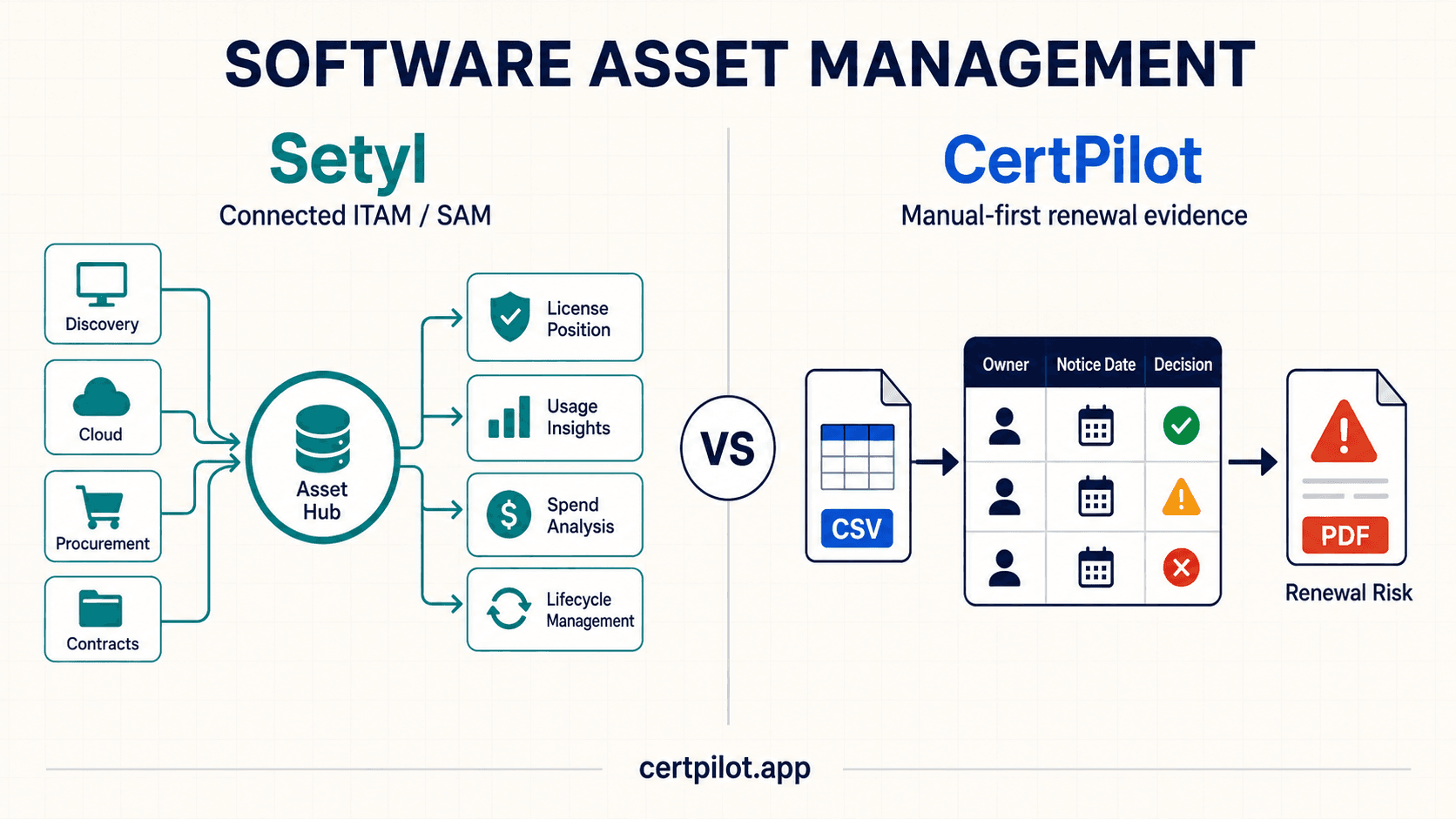
In short
-
Setyl is the stronger fit for connected software and hardware asset management, SaaS discovery, license allocation and usage, spend analysis, shadow IT, employee lifecycle automation, and vendor-management workflows.
-
CertPilot is the stronger fit for a lean, manual-first register with clear owners, renewal dates, notice deadlines, decision status and notes, CSV portability, reminders, and a Renewal Risk Report.
-
Setyl advertises more than 100 native integrations and unlimited hardware assets, software assets, and licenses across its plans. Integration depth still needs to be verified for each source and workflow.
-
CertPilot deliberately has no Google Workspace, Microsoft 365, finance, HRIS, MDM, RMM, inbox, invoice, or contract-parsing connector. Records are entered manually or imported by CSV.
-
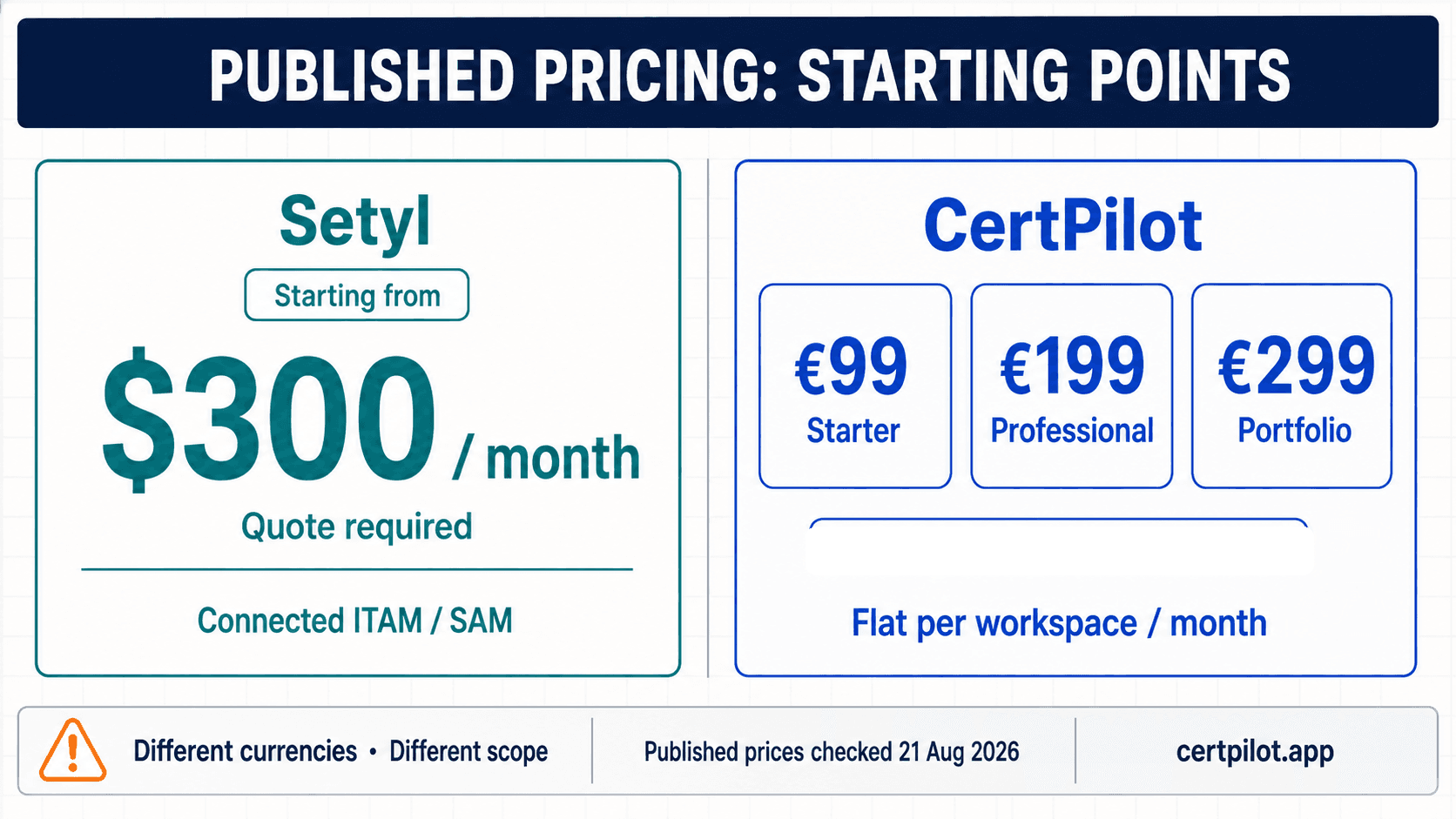
Setyl's published pricing starts at $300 per month and requires a quote. CertPilot publishes flat workspace prices of €99, €199, and €299 per month.
-
Setyl's review footprint is positive but still modest: G2 shows 4.8/5 from 18 reviews, Capterra shows 4.9/5 from 26 reviews, and Trustpilot shows a 4.0 TrustScore from four older reviews. CertPilot does not yet have an established profile on those three platforms.
-
If unused-license detection or automatic application discovery is a hard requirement, CertPilot is not a Setyl replacement.
-
The best evaluation uses real data: ten applications, three renewals, one unused license, one leaver, one missing owner, and one contract with an early notice deadline.
Are Setyl and CertPilot direct alternatives?
Only for a narrow job: maintaining visibility over software, owners, costs, and renewal risk.
Setyl's Software Asset Management platform is part of a broader IT asset management system. Setyl says it can centralize application usage, licenses, spend, users, administrators, renewal dates, vendor security and privacy information, and employee lifecycle work. It can import and update data through identity, SSO, HR, finance, device-management, service-desk, business-app, and other integrations.
CertPilot's Renewal & Vendor Register organizes SaaS subscriptions, vendors, licenses, contracts, domains, and certificates around owners, dates, costs, and review context. Its Assets Register can also hold manual software records such as vendor, version, license type and status, assigned owner, renewal date, purchase date, license reference, and a masked key hint. Neither register discovers software or usage automatically.
The overlap is real, but the operating models are different:
-
Setyl helps build and maintain the inventory from connected systems, then uses that data for optimization and lifecycle workflows.
-
CertPilot gives a team a structured place to maintain selected facts and produce evidence from them.
-
Setyl is trying to reduce the manual work of finding, matching, allocating, and optimizing assets.
-
CertPilot is trying to make a manual governance process more accountable than a spreadsheet and calendar reminders.
If you are looking for a full Setyl replacement, compare Setyl with other ITAM, SAM, or SaaS-management platforms. If you are looking for a lower-cost way to stop renewals being ownerless, undocumented, or missed—and you can supply the data—CertPilot is a credible narrower alternative.
Setyl vs CertPilot: side-by-side comparison
- Primary job: Setyl: Connected IT asset management across hardware, software, people, spend, and vendors CertPilot: Manual-first IT governance registers and evidence reports Practical conclusion: Different categories with overlap in software records and renewals
- Software inventory: Setyl: Central software catalog with users, admins, licenses, costs, renewals, and vendor context CertPilot: Customer-entered software records in Assets plus vendor/renewal records in Renewals Practical conclusion: Setyl for a richer operating inventory; CertPilot for selected evidence fields
- Automatic discovery: Setyl: Uses connected identity, finance, business, and other systems to identify and update software CertPilot: No automatic discovery Practical conclusion: Setyl
- Shadow IT detection: Setyl: Supported through connected-system signals CertPilot: Not available Practical conclusion: Setyl
- Native integrations: Setyl: 100+ advertised, including identity, HR, MDM/RMM, finance, service desk, and business apps CertPilot: No private-system connectors Practical conclusion: Setyl for automation; CertPilot for a smaller access surface
- CSV import/export: Setyl: Import and data-management paths exist; confirm exact export scope in trial CertPilot: CSV import and export for Assets and Renewals Practical conclusion: Both; test field-level portability
- License assignment: Setyl: Maps licenses to employees and can show availability CertPilot: Records license type/status and assignee manually Practical conclusion: Setyl for current allocation intelligence
- Usage intelligence: Setyl: Uses integration data, License Intelligence, and employee surveys CertPilot: No usage telemetry Practical conclusion: Setyl
- License rightsizing: Setyl: Designed to expose unused or unnecessary licenses CertPilot: Not available Practical conclusion: Setyl
- Spend analysis: Setyl: Breakdowns by location, department, vendor, and employee CertPilot: Stores cost per renewal record; no automated spend analytics Practical conclusion: Setyl for analysis; CertPilot for a maintained cost field
- Renewal dates: Setyl: Renewal timeline with notice periods and owner notifications CertPilot: Renewal date, notice deadline, alerts, digest, owner, purchaser, and decision context Practical conclusion: Both; CertPilot is manual-first
- Renewal decisions: Setyl: Renewal workflow and owner context within the wider SAM process CertPilot: Decision status, notes, last-reviewed date, owner signals, and Renewal Risk Report Practical conclusion: CertPilot makes the manual decision record explicit
- Auto-renew flag: Setyl: Renewal and contract context; verify exact flag behavior in trial CertPilot: Records auto-renew and changes due-soon reminder behavior Practical conclusion: CertPilot documents a specific manual control
- Contract or invoice parsing: Setyl: Integrates with finance and other data sources; confirm document-extraction capability CertPilot: No contract, inbox, payment-card, or invoice parsing Practical conclusion: Do not assume either extracts every contract clause
- Vendor management: Setyl: Vendor ownership, technical, contractual, security, privacy, audits, and onboarding workflows CertPilot: Vendor and billing contacts, owners, dates, costs, notes, and renewal decisions Practical conclusion: Setyl is broader
- Onboarding/offboarding: Setyl: Connected employee lifecycle workflows and alerts CertPilot: No automated onboarding or offboarding Practical conclusion: Setyl
- Hardware assets: Setyl: Full hardware asset-management capabilities and integrations CertPilot: Manual hardware register only Practical conclusion: Setyl for ITAM operations
- Device discovery or MDM: Setyl: Can connect MDM and RMM sources CertPilot: No device agent, scan, MDM, RMM, or network discovery Practical conclusion: Setyl
- Evidence output: Setyl: Dashboards, reports, lifecycle records, and vendor/compliance context; inspect exact exports CertPilot: Dedicated Renewal Risk PDF plus cross-module Governance Evidence Pack; software assets appear as summary counts only Practical conclusion: Depends on stakeholder and required detail
- Dedicated software-assets PDF: Setyl: Confirm the report/export needed during evaluation CertPilot: No dedicated Assets PDF Practical conclusion: Test rather than infer from dashboards
- Public domain checks: Setyl: Not the focus of this comparison CertPilot: Daily SSL/TLS, DNS, RDAP/domain-expiry, and email-authentication checks Practical conclusion: CertPilot
- Published price: Setyl: Complete, Advanced, and Advanced Managed each advertised as starting from $300/month; quote required. CertPilot: €99 Starter, €199 Professional, and €299 Portfolio per workspace/month. Practical conclusion: CertPilot has the lower published entry price but much less automation.
- Free trial: Setyl: request access and confirm current terms. CertPilot: 14 days with no credit card. Practical conclusion: CertPilot publishes a self-serve evaluation path.
- Best fit: Setyl: Organizations that need a connected asset system and can operationalize integrations CertPilot: Lean teams that can maintain records but need owners, renewal controls, and evidence Practical conclusion: Choose by operating model, not feature count alone This comparison reflects public pages checked on 21 August 2026. Setyl's capabilities can depend on plan, integration, and source-system permissions. CertPilot remains manual-first and does not become an automated SAM platform simply because its register contains software fields.
The core difference: asset intelligence or governance evidence
Software asset management includes several jobs that are often collapsed into one product category:
-
discover which applications and licenses exist;
-
reconcile duplicates and connect software to people or devices;
-
measure allocation and actual usage;
-
understand contract, cost, notice, and renewal obligations;
-
decide whether to renew, reduce, replace, or cancel;
-
execute the change; and
-
preserve evidence of the decision and outcome.
Setyl addresses more of that chain. Its integrations and intelligence features are intended to populate and update the system, expose usage and spend, and connect software decisions to employees, hardware, vendors, and lifecycle events.
CertPilot starts later in the chain. Your team supplies the inventory and renewal facts. CertPilot then helps reveal missing dates or ownership, highlight overdue and upcoming items, keep decision context, send reminders, and generate evidence reports.
That creates two different failure modes.
With Setyl, the risk is assuming that an integration count guarantees complete or accurate coverage. A connector may sync users but not entitlements, import spend without usage, or exclude a long-tail app. Matching and workflow configuration still need owners.
With CertPilot, the risk is stale manual data. A new subscription, owner change, price increase, or leaver is invisible until somebody records it. A clean dashboard cannot compensate for an incomplete register.
The right product is the one whose failure mode your team can detect and control.
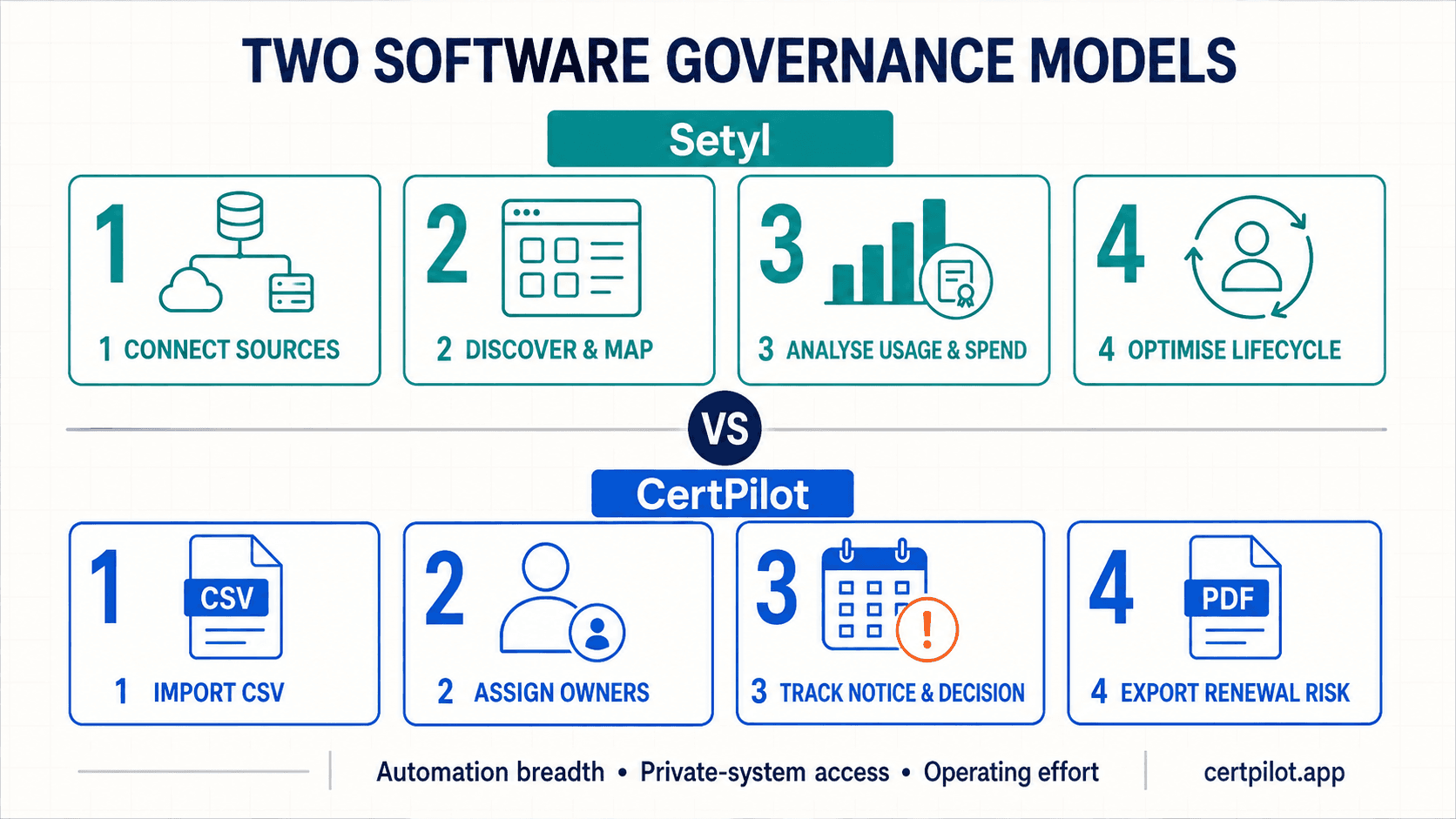
How Setyl approaches software asset management
Setyl's published workflow is built around centralizing software, people, usage, spend, renewals, and vendor risk instead of maintaining separate lists.
1. Connect the systems that already contain software signals
Setyl advertises more than 100 integrations across Google Workspace and Microsoft 365, SSO/IAM/IdP, HR systems, MDM and RMM tools, service desks, finance systems, business applications, and an API. Its pricing page names examples including Intune, Jamf, NinjaOne, CrowdStrike, and Iru.
This can reduce initial inventory work, but buyers should inspect each integration at the field level. Ask whether it discovers the application, imports assigned users, measures activity, imports invoice or spend data, identifies administrators, or enables a lifecycle action. “Integrated” is not a uniform capability.
2. Build a usable software and license inventory
Setyl's software asset page describes a central view of applications, contracts, licenses, costs, renewal dates, pricing, users, administrators, and vendor security or privacy details. Software can be mapped to employees and organizational context, making the inventory useful for both IT and finance conversations.
The advantage over a spreadsheet is not merely more fields. The connected model can reveal an application through more than one source and help the team reconcile what was purchased, assigned, and observed.
3. Analyze usage and rightsize licenses
Setyl combines connected IAM, SSO, and identity-provider data with License Intelligence, AI platform signals, and employee surveys. Its product page says teams can map license assignment, usage, and availability and receive offboarding alerts.
This is the largest functional gap between Setyl and CertPilot. CertPilot can record that a license exists and who owns or uses it, but it cannot observe inactivity, recommend a lower tier, or identify duplicated and unused subscriptions automatically.
Any savings estimate should still be validated. A low login count may reflect seasonal use, an emergency tool, an API-only workload, or a license required by contract. Usage intelligence should start a decision, not make it without an owner.
4. Manage renewal and notice timing
Setyl provides a renewal timeline with notice periods and can notify software owners as those dates approach. That matters because the economically important deadline is often the cancellation or non-renewal notice date, not the invoice date.
The value of the connected inventory is context: the owner can review users, utilization, price, contract data, and vendor information before the decision. During a trial, verify who receives notices, which channels are available, how escalation works, and whether a decision can be audited later.
5. Connect vendor and employee lifecycle work
Setyl extends beyond the renewal calendar. Its vendor-management features include ownership, contractual, technical, security, and privacy information plus vendor audits, onboarding workflows, and questionnaires. Connected sources can also identify unregistered vendors.
The platform also supports onboarding and offboarding processes. This can help recover licenses when an employee leaves and reduce the gap between an HR event and software reassignment.
For an organization that wants one operating system for hardware, software, people, spend, and vendors, this breadth is Setyl's main advantage.
How CertPilot approaches software assets and renewals
CertPilot separates the working records into two manual-first registers and then turns those records into evidence.
1. Record software in the Assets Register
The Assets Register can hold software name, vendor, category, version, license type and status, assigned owner, optional linked hardware, license reference, purchase and renewal dates, invoice reference, notes, and either a key-present flag or masked key hint.
CertPilot is not a credential or license-key vault. Full software keys should remain in an appropriate secrets or license-management system. It is also not an endpoint inventory tool: there is no agent, device scan, network discovery, barcode workflow, procurement approval, depreciation schedule, or MDM/RMM connector.
Teams can enter records manually or import and export them by CSV. That is useful when a spreadsheet already exists, but the data stays current only if the team maintains it.
2. Track commercial obligations in the Renewal & Vendor Register
The Renewal & Vendor Register can cover SaaS subscriptions, software licenses, contracts, vendors, domains, and certificates. Records include an owner, billing contact, renewal date, cost, and notes, with operational states such as overdue, upcoming, renewed, and incomplete.
Additional decision fields include the notice deadline, auto-renew setting, decision status—undecided, renew, cancel, or review—decision notes, last-reviewed date, technical owner, purchaser, payment-method label, and vendor support contact.
These fields are designed to answer practical questions:
-
Who owns the service?
-
When does the cancellation window close?
-
Does it renew automatically?
-
Has anybody reviewed the decision recently?
-
Are we renewing, cancelling, or still evaluating?
-
Who bought it and who can contact the vendor?
CertPilot does not parse the contract to find these facts. The team must enter and validate them.
3. Use reminders and risk signals as a decision queue
CertPilot can send renewal alerts and a digest based on configured timing and timezone. It derives risk signals from missing ownership, missing dates, overdue items, upcoming deadlines, and decision context.
The auto-renew flag has a specific operational effect: it can suppress ordinary due-soon manual reminders where an item is expected to renew automatically. It does not make unresolved risk disappear. Missing owner, missing date, or overdue conditions remain relevant.
This is not license optimization. CertPilot cannot tell whether 14 of 60 seats are unused. Its job is to prevent a known renewal from reaching a deadline with no accountable decision.
4. Generate renewal evidence
The dedicated Renewal Risk Report summarizes renewal exposure and includes decision and ownership risk. Renewal data also feeds broader on-demand evidence such as Monthly Proof, Weekly Governance, and the Governance Evidence Pack.
Software assets do not have a dedicated Assets PDF. They appear only as summary counts in the cross-module Governance Evidence Pack, not as owner-level or license-level detail. If a detailed software inventory export is required, use CSV and validate the format with the intended recipient.
5. Understand the two-register boundary
A software renewal date can appear in the Assets Register and the Renewal & Vendor Register, but CertPilot does not currently synchronize the two records. Use the Assets Register for the software inventory and the Renewal register for the commercial decision workflow, then define which field is authoritative.
Without that rule, the same renewal can have two different dates. A simple operating procedure is to keep detailed renewal timing and decisions only in the Renewal register and use the software record to link people, license context, and the inventory.
Discovery, freshness, and data quality
Setyl is better positioned to answer “What software exists?” because it can gather signals from connected systems. CertPilot can answer only “What has our team recorded?”
Automatic collection is not the same as perfect truth. A strong Setyl implementation should reconcile at least four populations:
-
applications detected through SSO or identity systems;
-
expenses and invoices from finance sources;
-
direct contracts maintained by procurement or department owners; and
-
accounts or licenses shown inside the vendor's own admin console.
Any mismatches become a work queue. For example, an expense with no registered app may indicate shadow IT, while an assigned license with no recent use may be a rightsizing candidate.
A strong CertPilot process needs an explicit collection schedule because there is no discovery layer. Assign a person to reconcile finance exports, identity-provider applications, browser or expense records where permitted, departmental lists, and the renewal register. Record the source and date of the review in decision notes.
If nobody owns reconciliation, neither product can produce a trustworthy inventory. Setyl can reduce the effort and surface more signals; CertPilot makes the manual work visible but cannot perform it.
License optimization and software spend
Setyl is the clear choice when the business case depends on recovering unused licenses or analyzing spend across departments, locations, vendors, and employees. Its product pages describe allocation, usage, availability, shadow IT, and cost breakdowns designed for that job.
CertPilot stores costs and software license context, but it has no usage telemetry, financial connectors, tier recommendations, seat-reclamation automation, or waste analysis. A team could manually add observations to notes and make a renewal decision, but that would be a human process outside the platform.
When calculating value, avoid turning every inactive user into a saving. Use a simple validation sequence:
-
confirm the user and license are still assigned in the vendor console;
-
distinguish login activity from actual feature or API use;
-
ask the owner whether the license supports seasonal, recovery, or regulatory work;
-
check contract constraints and minimum commitments;
-
reclaim or downgrade in a controlled window; and
-
verify the next invoice or contract amendment.
Setyl can make that queue easier to find and manage. CertPilot can record the renewal decision after the analysis, but it does not create the usage evidence.
Renewal management and vendor decisions
Both products can improve renewal discipline, but Setyl surrounds the decision with more automated context while CertPilot provides a deliberately explicit manual record.
For a high-value renewal, the decision packet should include:
-
contract end date and non-renewal notice deadline;
-
auto-renew status;
-
current annual or monthly cost and proposed increase;
-
contract owner, technical owner, and purchaser;
-
assigned seats, active usage, and expected headcount;
-
security, privacy, resilience, and support concerns;
-
migration or cancellation lead time;
-
decision, rationale, approver, and next action; and
-
evidence that the vendor was notified before the deadline.
Setyl can provide more of the operating and usage context and supports broader vendor workflows. CertPilot can hold the dates, owners, cost, decision status, and notes and surface them in its Renewal Risk Report. It does not negotiate, cancel the service, interpret contract language, or prove that a notice email was delivered.
The practical difference is this: Setyl is designed to help the team investigate and optimize the software estate; CertPilot is designed to ensure a known renewal has an owner and a documented decision.
Evidence, compliance, and audit expectations
Neither product certifies a company as compliant. Software inventory, access, ownership, renewal decisions, and vendor records can support controls, but an auditor or assessor determines whether the evidence is sufficient.
Setyl's wider asset and vendor model may be more useful when evidence needs to trace relationships across employees, devices, software, spend, contracts, and vendor assessments. Ask for sample exports that match the framework and auditor request rather than relying on screenshots.
CertPilot's advantage is a set of dated, opinionated PDF evidence reports. For this comparison, the relevant artifact is the Renewal Risk Report. The Governance Evidence Pack can summarize asset coverage, but it does not expose detailed software license or owner rows. CSV is the detailed portability path.
Before buying either product, give a sample output to the actual stakeholder—finance, management, a client, or an auditor—and ask:
-
Can we identify the source population and extraction date?
-
Is the responsible owner visible?
-
Are exceptions and missing data distinguishable from normal records?
-
Does the output preserve the renewal decision and rationale?
-
Can we retrieve the same evidence after a plan change or cancellation?
-
What external proof is needed for cancellation, invoice, usage, or source-system state?
A polished dashboard is not evidence if the data lineage and decision cannot be explained.
Pricing: Setyl vs CertPilot
Setyl's pricing page lists Complete, Advanced, and Advanced Managed, each starting from $300 per month and each requiring a pricing request. Setyl says pricing is based on plan and company size. Plans include unlimited hardware assets, software assets, and licenses; Advanced Managed adds expert-led implementation and ongoing managed data services.
CertPilot publishes Starter at €99, Professional at €199, and Portfolio at €299 per workspace per month. Starter includes the live registers and on-demand evidence reports. CertPilot offers a 14-day trial without a credit card.
- Setyl Complete: from $300/month, or from $3,600/year at monthly list price. Quote required; broader ITAM and integrations.
- Setyl Advanced: from $300/month, or from $3,600/year at monthly list price. Quote required; adds deeper functionality and intelligent cost insight.
- Setyl Advanced Managed: from $300/month, or from $3,600/year at monthly list price. Quote required; managed onboarding and data maintenance.
- CertPilot Starter: €99/month, or €1,188/year at monthly list price. Flat workspace; live registers and reports included.
- CertPilot Professional: €199/month, or €2,388/year at monthly list price. Adds capabilities such as grouping and branding.
- CertPilot Portfolio: €299/month, or €3,588/year at monthly list price. Higher-capacity portfolio plan.
These amounts are not directly convertible into a percentage saving because they use different currencies, Setyl publishes a starting price rather than a final quote, and the products deliver different capabilities. Taxes, discounts, onboarding, managed services, implementation effort, and exchange rates are excluded.
The published numbers still reveal the buying threshold. CertPilot Starter's numeric monthly price is about one-third of Setyl's advertised starting figure—€99 versus $300—while CertPilot Portfolio's numeric annual list price is close to Setyl's advertised floor—€3,588 versus $3,600. Currency and scope make those observations directional, not a price-equivalence claim.
Calculate total cost with this model:
Annual platform fees + implementation + integration administration + manual data maintenance + reporting effort − validated software savings
Setyl may justify a higher price if it identifies unused software, avoids duplicate purchases, shortens offboarding, or reduces reconciliation work. CertPilot may be better value when the estate is small, source data is already available, and the real problem is weak ownership and renewal evidence. The cheapest subscription is not the cheapest operating model if it creates work the team will not complete.
What Setyl reviews say on G2, Capterra, and Trustpilot
Independent reviews are useful for finding implementation questions, but Setyl's samples are still too small to predict every organization's experience.
G2: positive usability and integration signal
G2 shows Setyl at 4.8/5 from 18 reviews, with 17 five-star reviews and one four-star review when checked on 21 August 2026. Visible reviewers commonly praise the interface, responsive support, connectors, centralized asset visibility, and renewal ownership.
The cautions are equally useful. Individual reviewers mention occasional import or integration issues, a desire for more automation and report customization, and requests for a mobile app. Some reviewers say the support team resolved issues quickly. Treat those comments as prompts for testing, not universal product defects.
Capterra: strong rating, small sample
Capterra shows Setyl at 4.9/5 from 26 reviews, with 5.0 for ease of use, 4.8 for features, and 5.0 for customer service at the time of research. Reviewers often highlight ease of implementation, support, integrations, and having assets in one place.
Visible reservations include requests for bulk check-out, more automation or reporting customization, and cases where smaller organizations did not use every feature. These points suggest a useful trial question: will the organization adopt Setyl's breadth, or pay for a platform whose workflows remain unused?
Trustpilot: too little and too old for a strong conclusion
Trustpilot shows Setyl with a 4.0 TrustScore from four reviews. The visible reviews are from 2021–2023, there were no reviews in the preceding 12 months, and one reviewer explicitly said they had not used the company or product.
That makes Trustpilot a weak product-quality signal here. G2 and Capterra have more relevant samples, but they are still modest. Check reviewer company size, role, use case, review source, and date before applying a comment to your environment.
CertPilot did not have an established product profile on G2, Capterra, or Trustpilot in searches performed on 21 August 2026. That is a lack of independent review evidence, not evidence that users are dissatisfied. A buyer should compensate with a hands-on trial, sample reports, support interactions, security documentation, and customer references where available.
Which product should you choose?
Choose Setyl when
-
You need to discover software through connected systems rather than maintain the whole inventory by hand.
-
License assignment, activity, availability, and rightsizing are part of the business case.
-
Finance, identity, HR, device, or service-desk integrations should inform the software record.
-
You want software, hardware, employees, vendors, and spend in one ITAM platform.
-
Onboarding and offboarding should trigger software lifecycle work.
-
Vendor audits, questionnaires, security, and privacy context belong in the same workflow.
-
Your team can assign owners to integration health, data matching, and workflow configuration.
-
The broader operational savings justify a quote-led price starting at $300 per month.
Choose CertPilot when
-
You already have a spreadsheet or exports and can maintain the records manually.
-
Your immediate problem is missing owners, dates, notice periods, review decisions, and evidence.
-
A €99 flat workspace starting plan fits better than a connected ITAM platform.
-
You prefer not to connect another vendor to identity, HR, finance, or device-management systems.
-
A dedicated Renewal Risk Report and wider public domain evidence are useful.
-
CSV portability matters more than automatic discovery.
-
You accept that usage, waste, contract interpretation, cancellation, and source-system changes happen outside CertPilot.
Keep a spreadsheet when
-
The software estate is genuinely small and changes rarely.
-
One accountable owner reviews every row on a fixed cadence.
-
Calendar reminders already include the notice deadline, not only the renewal date.
-
Version history and access controls are adequate.
-
A dated export is acceptable evidence.
-
No one needs connected discovery, spend analysis, or formal PDF reports.
A disciplined spreadsheet may be enough. Moving the same stale data into a product does not improve governance.
Consider another platform when
-
You need deep enterprise license reconciliation or publisher-specific compliance.
-
You require procurement approvals, contract repository and clause extraction, negotiation, or automated cancellation.
-
Your critical systems are not covered at the required integration depth.
-
You need complex depreciation, stockroom, barcode, service-management, or CMDB workflows.
-
You require endpoint telemetry or software metering that neither evaluated configuration proves.
Can Setyl and CertPilot be used together?
Yes, but the combination should have a clear division of responsibility.
Setyl could remain the authoritative ITAM and SAM system for discovered software, licenses, users, usage, lifecycle, and spend. CertPilot could be used for public domain checks, selected governance registers, and evidence reports that Setyl does not provide in the desired format.
There is no live Setyl-to-CertPilot synchronization. Copying every software asset and renewal into both tools creates duplicate work and conflicting dates. Before adopting both, define:
-
which system owns the software inventory;
-
which system owns the renewal and notice date;
-
where the final renew/cancel decision is recorded;
-
who verifies cancellation or license reclamation;
-
which evidence artifact is delivered to management or an auditor; and
-
how exceptions move between systems.
If Setyl already produces the inventory, renewal workflow, and evidence your organization needs, duplicating records in CertPilot is unlikely to add value. CertPilot should fill a distinct evidence or public-check gap, not mirror Setyl row for row.
A 14-day evaluation plan for software assets and renewals
Use the same known-answer dataset in both products. Avoid a clean demo tenant that hides reconciliation work.
Days 1–2: define the test population
Select ten applications containing:
-
three renewals in the next 120 days;
-
one contract with a notice deadline well before renewal;
-
one automatically renewing subscription;
-
one unused or uncertain license;
-
one employee who has left;
-
one application purchased outside central IT;
-
one missing owner;
-
one application with two license tiers; and
-
one vendor with an unresolved security or support concern.
Write down the correct owner, seat count, usage status, cost, dates, and intended decision before configuring either tool.
Days 3–5: test collection and reconciliation
For Setyl, connect only approved non-production or trial sources. Record the required privileges, fields imported, sync frequency, mapping accuracy, and unmatched records. Verify whether each integration supplies discovery, users, usage, spend, or lifecycle actions rather than treating connection as a binary result.
For CertPilot, time the CSV cleanup, import, field mapping, owner assignment, and manual reconciliation. Record which facts cannot be obtained without visiting vendor consoles, finance data, or contracts.
Measure coverage against the known-answer population. A faster import is irrelevant if critical records or dates are missing.
Days 6–8: test license and leaver workflows
Investigate the uncertain license. In Setyl, determine which source creates the usage signal and whether the result is sufficient to approve a downgrade or removal. In CertPilot, document how the team would gather the same evidence externally and preserve the conclusion in the renewal decision.
Process the former employee. Verify the license state in the vendor's system afterward. A dashboard update or completed task does not prove the underlying seat was reclaimed.
Days 9–11: run a real renewal decision
Choose the contract with the early notice deadline. Assign commercial and technical owners, document cost and usage, request security or service input, and decide to renew, review, reduce, or cancel.
Test reminders and escalation before the deadline. If cancelling, preserve the vendor acknowledgement or other external proof. Neither a Setyl status nor a CertPilot decision note replaces that evidence.
Days 12–14: inspect outputs and calculate total cost
Export the software inventory, renewal view, decision record, and evidence report. Give them to the person who will consume them without explanation. Ask what is missing and whether the data lineage is clear.
Then annualize subscription, implementation, integration maintenance, monthly reconciliation, quarterly review, and reporting effort. Credit software savings only after a license or contract change is verified on an invoice.
Questions to ask Setyl before buying
-
Which of our systems provide application discovery, assigned users, actual usage, license tier, spend, renewal data, and lifecycle action separately?
-
How frequently does each integration sync, and how are failures, stale data, and unmatched records exposed?
-
Which capabilities are available in Complete, Advanced, and Advanced Managed?
-
What determines the final price above the $300 monthly starting point—employee count, plan, integrations, entities, or services?
-
Are implementation, data migration, managed data maintenance, and support included in the quoted price?
-
How are duplicate applications and conflicting data from identity, finance, and vendor sources reconciled?
-
How is usage defined for API-only, seasonal, shared, service, and infrequently accessed accounts?
-
Can renewal notices escalate when an owner does not respond, and is the final decision history exportable?
-
Which vendor audit, questionnaire, and security workflows are included in our plan?
-
What data can we export, in which format, and what remains accessible after cancellation?
-
What OAuth scopes, service accounts, agents, or administrative privileges are required?
-
Can we see a sample output for the exact software, renewal, and evidence use cases in our evaluation?
Questions to ask CertPilot before buying
-
Who will reconcile identity, finance, department, and vendor-console data before each review?
-
Should a software renewal live only in the Renewal register to avoid duplicate dates in Assets?
-
Which workspace plan fits our domain capacity, groups, branding, and report needs?
-
Are scheduled renewal reminders and digest timing sufficient for our escalation process?
-
Which fields appear in the Renewal Risk Report, and does the recipient accept that artifact?
-
Is CSV detailed enough for the software inventory evidence we need, given there is no dedicated Assets PDF?
-
Who verifies usage and license reclamation outside CertPilot?
-
Where will contracts, invoices, full license keys, cancellation acknowledgements, and legal interpretations live?
-
How will owner or price changes be captured between review cycles?
-
Do the other included registers and public checks replace real work, or would they remain unused?
-
Is the lack of discovery and private-system integrations a useful security boundary or an unacceptable source of manual risk?
-
What is the exit path and how will all register data be exported?
Migration paths
From a spreadsheet to CertPilot
Clean the source before import. Normalize vendor names, separate renewal date from notice deadline, assign an accountable owner, identify auto-renewing items, and preserve the original source. Import by CSV, review incomplete records, then generate a Renewal Risk Report to validate what the process exposes.
Do not duplicate software renewal dates across Assets and Renewals without an ownership rule. Use the Renewal register as the commercial decision queue and the Assets register for inventory context.
From spreadsheets and disconnected systems to Setyl
Define authoritative sources before connecting them. Finance may own spend, the identity provider may own assigned users, the vendor console may own entitlement detail, and procurement may own contract terms. Import a limited population, resolve duplicates, verify connector permissions, and then expand.
Preserve the pre-migration inventory and contract documents. Automation should make reconciliation easier, not erase the historical source needed to explain a decision.
From CertPilot to Setyl
This move usually makes sense when manual maintenance becomes the bottleneck or the business case expands to discovery, usage, rightsizing, connected offboarding, or full ITAM. Export CertPilot records by CSV, map owners and renewal dates to Setyl, and keep Renewal Risk PDFs as historical evidence.
Run both processes for one renewal cycle only if needed for validation, then name one authoritative system to avoid permanent duplication.
Bottom line
Setyl is the stronger software asset management product. It is designed to discover and connect assets, people, licenses, usage, spend, renewals, vendors, and lifecycle work. That breadth can reduce manual reconciliation and uncover optimization opportunities, but it comes with a higher quote-led price, integration dependencies, and more implementation responsibility.
CertPilot is the narrower and less expensive governance option. It helps a lean team maintain software and renewal records, assign owners, track notice and decision context, receive reminders, and produce a Renewal Risk Report without private-system connections. It cannot find shadow IT, measure license usage, reclaim seats, parse contracts, or automate lifecycle changes.
Choose Setyl when connected inventory and optimization are requirements. Choose CertPilot when reliable ownership, renewal decisions, and evidence are the immediate problem and your team can supply the data. Keep a spreadsheet if it is small, controlled, and consistently reviewed. In every case, test a real renewal and verify the underlying license or contract outcome before buying.
Sources and verification notes
Product capabilities, public prices, and review-platform figures were checked on 21 August 2026. Prices exclude taxes, foreign exchange, discounts, implementation, and negotiated terms. Setyl integration capabilities and final pricing can vary by plan, source system, permissions, company size, and quote. Review ratings and counts can change.
Frequently Asked Questions
Is CertPilot a true Setyl alternative?
CertPilot is a Setyl alternative only for a narrower requirement: maintaining a manual software and renewal register with clear ownership, dates, decisions, reminders, CSV portability, and evidence reports. It can replace part of a spreadsheet-led renewal process.
It is not a full alternative to Setyl's connected IT asset management capabilities. CertPilot does not discover software, connect to identity or finance systems, observe usage, identify shadow IT, rightsize licenses, automate employee lifecycle work, or manage a full hardware estate. If any of those capabilities are selection criteria, compare Setyl with another ITAM, SAM, or SaaS-management platform. If the team already has reliable source data and mainly needs accountability around renewal risk, CertPilot may cover the required job with a lower published subscription price and fewer private-system connections.
Does CertPilot automatically discover software and licenses?
No. CertPilot's Assets and Renewal & Vendor registers are customer-entered and CSV-friendly. The team must gather records from identity systems, finance data, vendor consoles, contracts, invoices, department owners, or an existing spreadsheet and then import or maintain them.
This reduces the access CertPilot needs to private systems, but it makes freshness a human responsibility. A defensible process should define authoritative sources, reconciliation frequency, ownership, and how new purchases or leavers are captured. Setyl is the stronger fit when discovery and connected updates are required, although buyers should still verify what each Setyl integration actually imports. A connector that sees an application may not necessarily provide entitlement depth, usage, spend, and lifecycle action.
Which costs less: Setyl or CertPilot?
CertPilot has the lower published entry price. Setyl lists Complete, Advanced, and Advanced Managed as starting from $300 per month and requires a quote. CertPilot lists €99 Starter, €199 Professional, and €299 Portfolio per workspace per month.
The comparison is not like for like. The currencies differ, Setyl publishes a starting price, and CertPilot does not include Setyl's discovery, usage intelligence, rightsizing, integrations, spend analysis, or full ITAM workflows. Compare total cost: subscription, implementation, integration administration, manual maintenance, and validated software savings. Setyl can be better value if it reduces real license waste and operating effort. CertPilot can be better value when the inventory is manageable and the main requirement is a controlled renewal and evidence process.
Can CertPilot identify unused or duplicate software licenses?
No. CertPilot can record software, license status, assignee, cost, renewal dates, owners, and decision notes, but it does not collect application usage or finance signals. It cannot automatically identify inactive seats, duplicate tools, shadow IT, or downgrade opportunities.
Setyl is designed for that broader optimization job through connected sources, License Intelligence, identity data, and employee surveys. Even then, a usage flag should be validated before a seat is removed. Seasonal work, API use, emergency access, contractual minimums, and shared or service accounts can make a low-activity license legitimate. The final workflow should require an owner to review the evidence, approve the action, verify the vendor-side change, and confirm the resulting invoice or contract adjustment.
Which product is better for vendor renewals?
Setyl is stronger when a renewal decision should use connected license, usage, spend, employee, and vendor context. It provides a renewal timeline, notice periods, owner notifications, and broader vendor-management workflows.
CertPilot is strong for a lighter manual decision process. Its Renewal & Vendor Register records renewal and notice dates, auto-renew status, owner, technical owner, purchaser, billing context, cost, decision status, notes, and last-reviewed date. Alerts, a digest, and the Renewal Risk Report help turn those records into a queue. CertPilot does not read the contract, negotiate terms, cancel subscriptions, or prove that a notice was received. If automatic data collection and optimization matter, choose Setyl. If clear accountability and dated evidence are the priority, CertPilot may be sufficient.
What do Setyl reviews say?
The available review signal is favorable but modest. G2 shows Setyl at 4.8/5 from 18 reviews; reviewers often praise the interface, integrations, centralized asset view, and responsive support. Some visible reviews mention import or integration issues, requests for more automation or reporting customization, and interest in a mobile app.
Capterra shows 4.9/5 from 26 reviews, with strong ease-of-use and support scores. Visible cautions include missing bulk actions and smaller organizations not using every feature. Trustpilot shows a 4.0 TrustScore from only four older reviews, one from a person who said they had not used the product, so it is not a strong product signal. CertPilot had no established listing on these platforms during research; evaluate it through the trial, sample outputs, security material, and references.
Should you use Setyl and CertPilot together?
Yes, if each product has a distinct job. Setyl could be the authoritative system for discovered software, users, licenses, usage, spend, hardware, and lifecycle workflows. CertPilot could cover public domain checks and selected management-ready evidence or manual governance registers.
There is no live Setyl-to-CertPilot integration, so duplicating software and renewal records creates reconciliation risk. Define one system for the inventory, one for the renewal and notice date, one location for the final decision, and one evidence destination. If Setyl already meets the reporting and governance need, copying its data into CertPilot is unlikely to add value. Use both only where CertPilot fills a separate evidence or public-check gap rather than maintaining a second version of the same SAM data.